
Furnace Ignitor: Signs It Is Bad, How to Test It, and What Replacement Costs
A furnace ignitor is the part that lights the gas every time your furnace starts. When it fails, the furnace goes through the motions of starting up, but the burners never light and the house stays cold. It is one of the most common furnace repairs of the winter. Fortunately, it is also one of the fastest to fix.
This guide explains what the ignitor does, the signs that it is going bad, how to test it, how long it should last, and what replacement costs in 2026. Comfort Pros replaces ignitors across Brevard, Hendersonville, Asheville, and the rest of Western North Carolina every heating season, so the details below come from real service calls.
What a Furnace Ignitor Does
Older furnaces kept a small pilot flame burning all day. Modern furnaces do not. Instead, they use an electronic ignitor that creates heat only when the thermostat calls for it. As a result, the furnace saves gas, and there is no pilot light to blow out.
The startup order is always the same. First, the furnace inducer motor clears the combustion chamber. Next, the ignitor heats up. Then the gas valve opens, and the gas lights as it passes over the ignitor. Finally, the flame sensor confirms the flame, and the blower starts moving warm air.
Therefore, if the ignitor does not get hot enough, the gas has nothing to light it. The control board senses no flame and shuts the gas valve within a few seconds.
Types of Furnace Ignitors
Most homes in Western North Carolina have one of two types.
Hot Surface Ignitor
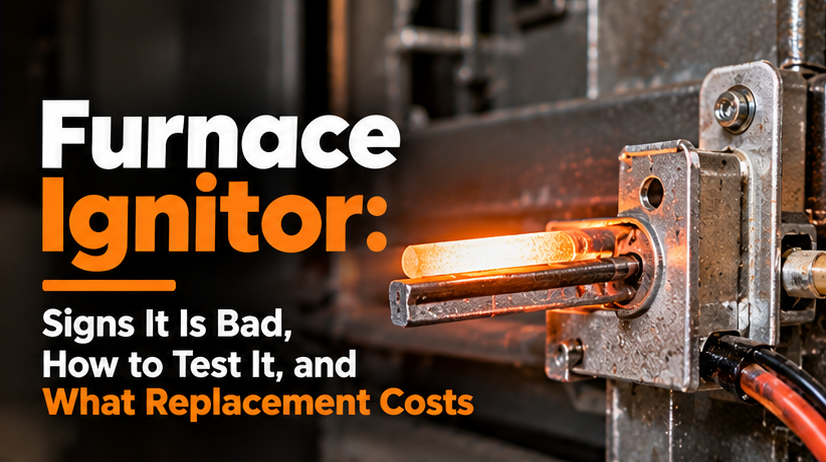
A hot surface ignitor is by far the most common type in furnaces built in the last 30 years. It is a small gray or black element made of silicon carbide or silicon nitride. When power flows through it, the element glows bright orange and reaches well over 2,000 degrees.
Silicon carbide ignitors are brittle and usually last three to five years. In contrast, silicon nitride ignitors are tougher and often last seven years or more. As a result, many technicians install a nitride ignitor as an upgrade when the original fails.
Spark Ignitor
A spark ignitor works like the one on a gas grill. It makes a rapid clicking sound as it throws a spark to light either a pilot or the main burner. These are less common in newer furnaces. However, some models still use them.
Where Is the Ignitor on a Furnace?
First, turn off the power and remove the upper furnace door. You will see a row of burners. The ignitor sits at one end of that row, mounted on a bracket so its tip points into the path of the gas.
Look for a small element with a white ceramic base and two wires leading to a plastic plug. The furnace flame sensor usually sits at the opposite end of the burners. People often confuse the two parts. However, the flame sensor is a single thin metal rod with only one wire.
7 Signs of a Bad Furnace Ignitor
An ignitor rarely fails without warning. Therefore, watch for these signs.
- The furnace starts but never lights. You hear the inducer fan run, then nothing. No whoosh of flame follows.
- The ignitor is not glowing. Through the small sight window, you should see an orange glow about 30 seconds after startup. No glow usually means a failed ignitor.
- The ignitor glows but there is no flame. A weak ignitor may glow dull orange without getting hot enough to light the gas.
- The furnace tries several times, then locks out. Most furnaces attempt ignition three to five times before shutting down for safety.
- The blower runs but the air is cold. Some furnaces run the fan after failed attempts. This is one cause of a furnace blowing cold air.
- You see a visible crack. A hairline crack or a white, chalky spot on the element means it has burned out.
- The furnace flashes an ignition error code. The diagnostic light on the control board often points to an ignition failure.
Several of these signs overlap with other problems. For example, if the furnace shows no signs of life at all, start with our checklist for a furnace not turning on instead.
Why Furnace Ignitors Fail
Every ignitor wears out eventually. Each heating cycle takes the element from room temperature to over 2,000 degrees and back again. Over time, that stress weakens the material. However, a few conditions shorten its life.
- Short cycling. A furnace that starts and stops too often uses up ignition cycles quickly. See why a furnace keeps turning on and off.
- A dirty filter. Restricted airflow causes overheating, which leads to more cycles.
- Skin oil on the element. Touching the element with bare fingers leaves oil that creates a hot spot and cracks it.
- Voltage problems. High voltage from the control board burns the element out early.
- Moisture and dust. Furnaces in damp crawlspaces see more ignitor failures.
How to Test a Furnace Ignitor
The simplest test is visual. First, set the thermostat to call for heat and watch through the sight window on the furnace door. Within about a minute, the ignitor should glow bright orange. If it stays dark, the ignitor or the power going to it has failed.
Next, a technician confirms the diagnosis with a multimeter. With the power off and the ignitor unplugged, a healthy silicon carbide ignitor typically reads between 40 and 90 ohms. Silicon nitride ignitors read lower. However, a reading of infinite resistance means the element is broken inside.
The second check is voltage. If the ignitor tests good but never glows, the control board may not be sending power. That is a different repair. Therefore, proper system diagnostics matter before anyone replaces a part.
Can You Clean a Furnace Ignitor?
We do not recommend cleaning it. Unlike a flame sensor, a hot surface ignitor is extremely fragile, and it does not fail because of dirt. Instead, it fails because the element wears out or cracks. Rubbing it with sandpaper or a cloth will usually break it.
Therefore, if the ignitor has stopped working, replacement is the correct fix.
Furnace Ignitor Replacement Cost
Furnace ignitor replacement is one of the more affordable furnace repairs. Typical ranges in 2026 look like this:
- Universal hot surface ignitor, part only: $20 to $50
- Brand specific ignitor, part only: $40 to $120
- Professional replacement, installed: $150 to $400
The installed price depends on the furnace brand, how hard the ignitor is to reach, and whether the visit is scheduled or urgent. At Comfort Pros, the visit starts with a flat $125 diagnostic, and we waive that fee when we complete the repair.
Should You Replace a Furnace Ignitor Yourself?
Some homeowners do replace their own ignitor. The job involves turning off the power and gas, unplugging the old ignitor, removing one or two screws, and installing the new part without touching the element.
However, there are real reasons to leave it to a professional. First, the part must match the furnace exactly, because the wrong ignitor can damage the control board. In addition, an ignitor that fails repeatedly is a symptom of another problem. A technician will check the voltage, the flame sensor, and the burners during the same visit. Our heating repair team carries the common ignitors on the truck, so we finish most replacements in one trip.
What Happens During a Professional Replacement
A professional visit covers more than the swap itself. First, the technician confirms that the ignitor is the failed part by testing resistance and voltage. Next, the new ignitor goes in, positioned so the gas passes directly over it. Then the technician runs the furnace through several full cycles.
Finally, the technician checks the flame sensor, the burners, and the filter, because those parts affect how long the new ignitor lasts. As a result, you get a repair that holds through the rest of the winter.
How to Make a Furnace Ignitor Last Longer
You cannot stop an ignitor from wearing out, but you can avoid shortening its life. First, change the air filter on schedule. Second, fix short cycling as soon as you notice it. Finally, keep the area around the furnace dry and free of dust.
A yearly tune-up also helps. During HVAC maintenance, a technician measures the ignitor's resistance and can spot a weak one before it fails on a cold night. ENERGY STAR recommends a professional checkup every fall in its maintenance checklist.
Frequently Asked Questions About a Furnace Ignitor
How long does a furnace ignitor last?
Most hot surface ignitors last three to seven years. Silicon carbide ignitors sit at the lower end of that range, and silicon nitride ignitors sit at the higher end. However, heavy use and short cycling shorten the lifespan.
Why is my furnace ignitor not glowing?
The element has most likely burned out or cracked. Less often, the control board is not sending power, or a safety switch is stopping the ignition sequence before it reaches that step.
Why does my furnace ignitor glow but there is no flame?
Either the ignitor is too weak to light the gas, or gas is not reaching the burners. For example, a closed gas valve, a failed gas valve, or dirty burners can each cause this.
Can a furnace run with a bad ignitor?
No. Without a working ignitor, the burners cannot light, and the furnace will lock out after several attempts. This is a safety feature that prevents unburned gas from building up.
Is a furnace ignitor the same as a flame sensor?
No. The ignitor lights the gas. Then the flame sensor confirms that the gas lit. They sit at opposite ends of the burners and fail in different ways.
Are furnace ignitors universal?
Universal ignitors exist and fit many furnaces with the right bracket and plug adapter. However, some furnaces need a specific voltage or shape, so always match the part to the furnace model.
Furnace Not Lighting? We Can Help
A failed ignitor is a small part and usually a quick repair. Comfort Pros serves Brevard, Hendersonville, Asheville, and the surrounding mountain communities, Monday to Friday 8:00am - 5:00pm, with a flat $125 diagnostic that we waive when we complete the repair.
Contact us or call (828) 393-0024, and we will test the ignitor, replace it if needed, and get your heat running again.
Related Post
One Response